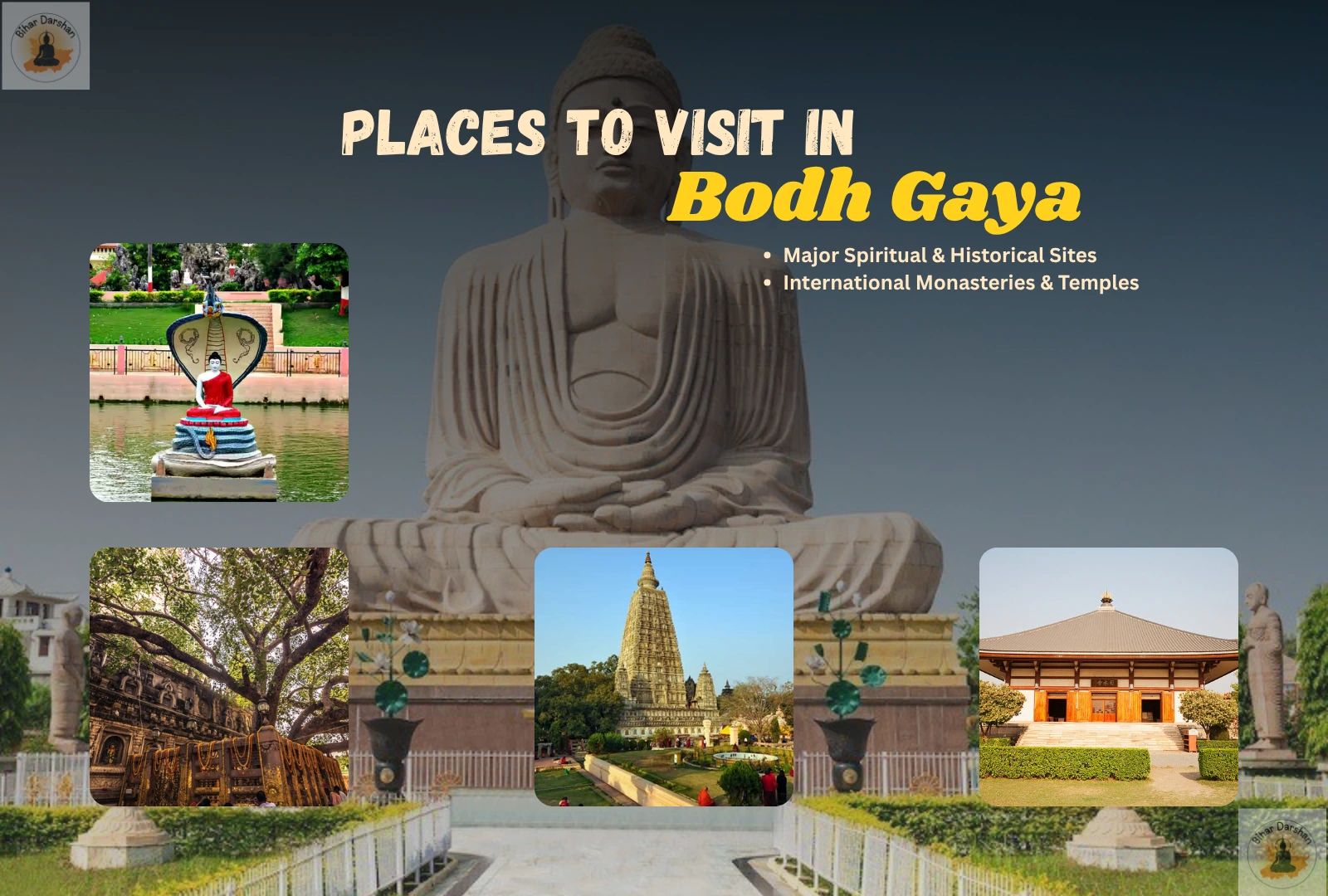
For Buddhists worldwide, Bodh Gaya in Bihar, India, is one of the holiest destinations. It is a major pilgrimage and spiritual centre because it is the location where Lord Buddha attained enlightenment under the revered Bodhi tree. Places to visit in Bodh Gaya include tranquil monasteries, ancient temples, and a tranquil atmosphere in addition to its religious significance. here are the Top Places To Visit in Bodh Gaya that you shouldn’t miss.
Here is a thorough guide to Bodh Gaya’s top tourist destinations, including must-see sights, monasteries, and neighbouring locations, if you’re organising a trip.
Table of Contents
Major Spiritual & Historical Sites
1. Mahabodhi Temple Complex (UNESCO World Heritage Site)
Situated in Bodh Gaya, Bihar, India, the Mahabodhi Temple Complex is a UNESCO World Heritage Site. It commemorates the location where, beneath the Bodhi tree, Siddhartha Gautama (the Buddha) achieved enlightenment in the sixth century BCE.
One of the oldest brick buildings still standing in India is the main temple, which was first constructed by Emperor Ashoka in the third century BCE and then rebuilt in the fifth and sixth centuries CE. The Bodhi Tree, the Vajrasana (Diamond Throne), a number of stupas, and monastic buildings from various eras are all part of the complex.
It is still a popular destination for Buddhists worldwide and a representation of spiritual enlightenment and tranquilly.
2. The Sacred Bodhi Tree
In Bodh Gaya, India, the Mahabodhi Temple Complex is home to the Sacred Bodhi Tree. It is thought to be a direct descendant of the original Bodhi tree, which is thought to have been the source of Siddhartha Gautama’s enlightenment some 2,500 years ago.
According to legend, the current tree originated from a sapling of the original tree, which was brought to Sri Lanka by Princess Sanghamitta, the daughter of Emperor Ashoka, and then replanted in Bodh Gaya.
One of Buddhism’s most revered symbols, the Bodhi tree is a symbol of wisdom, enlightenment, and peace that attracts monks and pilgrims from all over the world for prayer and meditation.
3. Great Buddha Statue
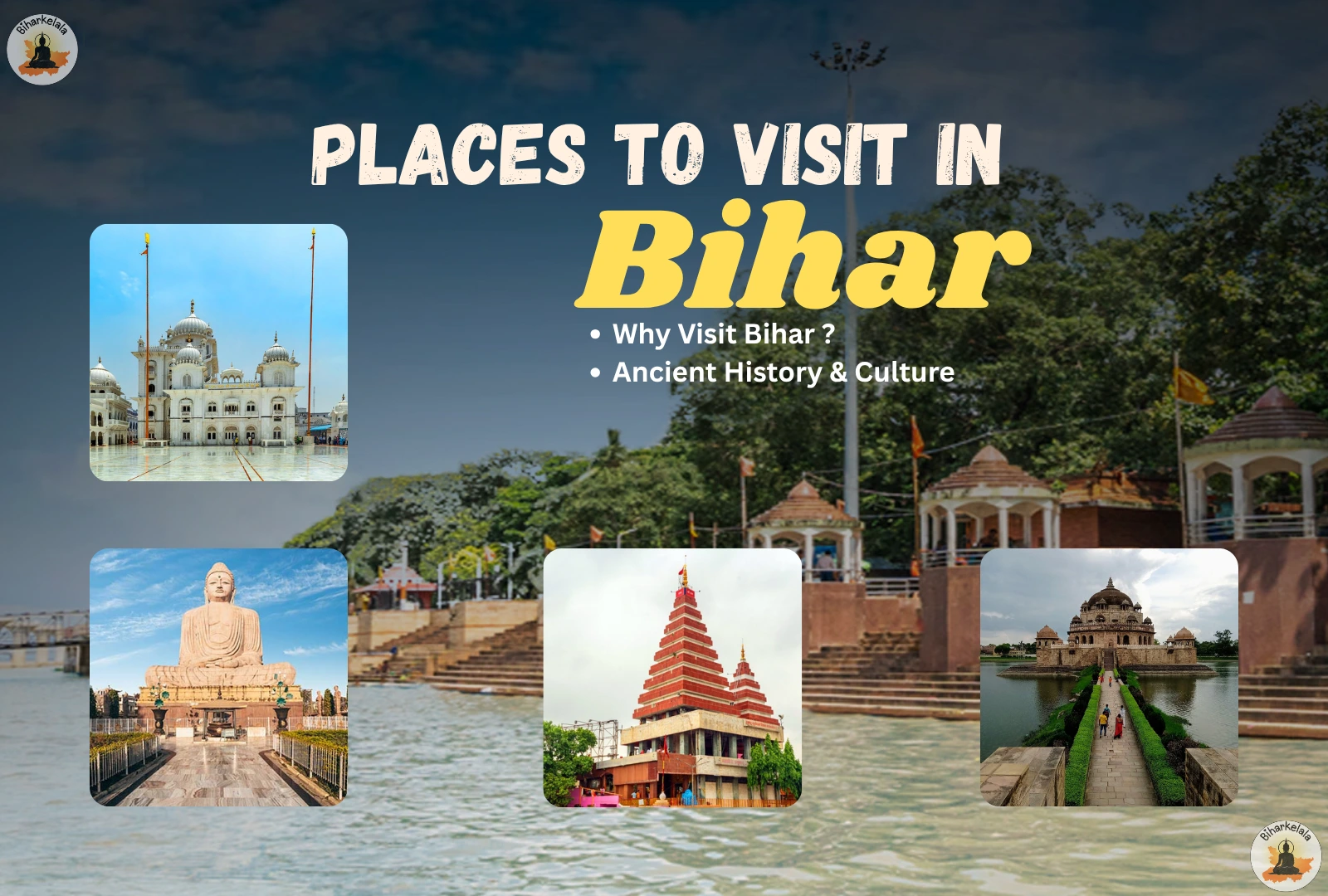
In Bodh Gaya, Bihar, the Great Buddha Statue is a revered monument that represents enlightenment and peace. Standing roughly 25 meters (82 feet) tall and depicting Lord Buddha in Dhyana Mudra, or deep meditation, on a lotus pedestal, it was dedicated in 1989 by the 14th Dalai Lama. With the combined efforts of Indian and Japanese artisans, the statue was constructed from red granite and sandstone over the course of almost seven years. Ten smaller statues of Buddha’s disciples surround it, and inside are about 17,000 miniature bronze Buddhas. Reflecting Bodh Gaya’s ongoing connection to the Buddha’s teachings, the statue draws in thousands of pilgrims and tourists annually and turns into a significant spiritual hub during Buddha Jayanti.
4. Muchalinda Lake
Situated next to the Mahabodhi Temple in Bodh Gaya, Bihar, Muchalinda Lake is a calm and revered location that is strongly associated with Lord Buddha’s life. Buddhist tradition states that a great storm occurred while the Buddha was meditating close to this location after achieving enlightenment. The serpent king, Muchalinda, came out of the lake and covered the meditating Buddha with his hood to shield him from the wind and rain. This deed represents inner strength, tranquilly, and protection. Visitors are reminded of this legend by a statue of Buddha in the middle of the lake, protected by the serpent king. Pilgrims and tourists alike are drawn to Muchalinda Lake, which is surrounded by greenery and serene waters and provides a tranquil setting for meditation and introspection.
International Monasteries & Temples
1. Thai Monastery
In order to foster cultural and spiritual ties between Thailand and India, the Thai government and Buddhist monks constructed the tranquil and exquisite Thai Monastery in Bodh Gaya, India. It was founded in 1957 and, with its golden roof, elaborate carvings, and elegant curves, embodies traditional Thai architectural design. The monastery is a hub for Buddhist study, meditation, and cross-cultural interaction. It provides pilgrims and tourists with a serene and spiritual environment, surrounded by serene gardens and Buddha statues. The local monks invite everyone to participate in Thai Buddhist customs by holding frequent prayers and ceremonies. It represents peace, devotion, and the two countries’ common Buddhist heritage.
2. Japanese (Indosan Nippon) Temple
The Japanese (Indosan Nippon) Temple in Bodh Gaya is a beautiful symbol of peace and devotion, built by the Japanese Buddhist community in 1972. The temple’s straightforward wooden interiors, sloping roofs, and serene atmosphere are all examples of traditional Japanese architectural design. A huge golden statue of Lord Buddha, who exudes compassion and tranquilly, sits inside in deep meditation. A serene meditation hall and a museum showcasing Buddhist texts and artwork are also located within the temple complex. It offers a serene setting for introspection and spiritual practice, surrounded by an abundance of greenery. As a representation of friendship between Japan and India, the Indosan Nippon Temple spreads the Buddhist teachings of mindfulness, peace, and harmony to everyone who visits.
3. Tibetan Monastery
One of the liveliest and most spiritually rich Tibetan Buddhist centres in India is the Tibetan Monastery in Bodh Gaya, also called the Karma Temple. It was constructed by the Tibetan community and features traditional Tibetan architecture, including prayer wheels encircling the temple, elaborate wall paintings, and vibrant frescoes. A majestic statue of Maitreya Buddha, the future Buddha, is the main attraction inside. Monks chant beautiful mantras in the monastery’s spacious prayer hall, which fosters a profound sense of devotion and tranquilly. Prayer flags of various colours fly about, signifying kindness and generosity. The Tibetan Monastery provides visitors with an insight into Tibet’s rich spiritual and artistic legacy while acting as a centre for Buddhist education, meditation, and cultural preservation.
4. Vietnamese Temple
The Vietnam Buddhist Temple, also called Linh Son Temple or the Vietnamese Temple in Bodh Gaya, is a calm and tasteful location that embodies Vietnamese Buddhist devotion and culture. The temple, which was constructed by the Vietnamese Buddhist community, has exquisite carvings, curved roofs, and a sizable statue of Lord Buddha in meditation. The serene surroundings, which are dotted with statues and gardens, provide the perfect setting for prayer and introspection. Inside, the temple’s exquisitely crafted altars and murals capture the spirit of Vietnamese spirituality and art. It represents the spiritual ties between Vietnam and India, the birthplace of Buddhism, and acts as a hub for worship, meditation, and cross-cultural interaction.
5. Royal Bhutan Monastery
A magnificent illustration of Bhutanese architecture and Buddhist devotion can be found at the Royal Bhutan Monastery in Bodh Gaya. It was constructed by the Bhutanese king and acts as a bridge of culture and spirituality between India and Bhutan. Traditional Bhutanese artistry is reflected in the monastery’s colourful paintings, elaborate wood carvings, and golden spires. Inside, surrounded by murals that portray his life and teachings, a magnificent statue of Lord Buddha sits in deep meditation. A profoundly spiritual atmosphere is produced by the serene surroundings, prayer flags, and chanting monks. The monastery serves as a hub for Buddhist education and meditation in addition to being a place of worship. It beautifully represents Bhutan’s rich cultural heritage and its deep reverence for the teachings of Lord Buddha.
6. Chinese Temple
The Chinese Buddhist community constructed the elegant and tranquil Chinese Temple in Bodh Gaya as a tribute to the hallowed location of Buddha’s enlightenment. The temple’s curved roofs, vivid red pillars, and elaborate golden decorations are examples of traditional Chinese architecture. Impressive statues of Lord Buddha and Bodhisattvas can be found inside, along with exquisite Chinese calligraphy and paintings that illustrate various events in the life of the Buddha. Meditation and introspection are encouraged by the serene and spiritual ambiance. The temple’s monks regularly perform rituals and prayers in accordance with Chinese Buddhist customs. The Chinese Temple, which is surrounded by verdant gardens and serene courtyards, represents friendship between China and India and fosters peace, compassion, and spiritual unity.
Nearby Attractions
1. Dungeshwari Cave Temples (Mahakala Caves)
About 12 kilometres from Bodh Gaya are the holy Dungeshwari Cave Temples, also called the Mahakala Caves. Before achieving enlightenment at Bodh Gaya, Lord Buddha is said to have meditated in these ancient caves for several years. Little shrines to the Hindu goddess Dungeshwari and Lord Buddha can be found in the caves. A placid statue of the gaunt Buddha inside symbolises his time of intense austerity. Pilgrims and seekers from all over the world are drawn to the caves because of their serene and natural surroundings, which foster a profoundly spiritual atmosphere. The Buddha’s journey of struggle, realisation, and eventual discovery of the Middle Way—a lesson in wisdom and balance for all of humanity—is symbolised by the Dungeshwari Caves.
2. Barabar Caves (about 40 km away)
The oldest surviving rock-cut caves in India are the Barabar Caves, which date to the Mauryan period (3rd century BCE) and are situated roughly 40 kilometres from Bodh Gaya. They were utilised by the Ajivika sect and were carved during the reign of Emperor Ashoka. The caves exhibit ancient craftsmanship and spiritual heritage with their exquisitely engraved walls and highly polished interiors.
3. Sujata Stupa & Village
Sujata Stupa and Village, situated across the Niranjana River from Bodh Gaya, commemorates the moment when a good-hearted villager named Sujata gave Siddhartha Gautama rice and milk prior to his enlightenment. To commemorate her kindness and generosity, the stupa was constructed. Visitors are reminded of the Buddha’s discovery of the Middle Path and the value of kindness and balance in life by the serene village and historic stupa.
Cultural & Local Experiences
1. Bodh Gaya Museum
A vast collection of Buddhist sculptures, artefacts, and relics from the first century BCE to the eleventh century CE can be found at the Bodh Gaya Museum, which is close to the Mahabodhi Temple. It provides important insights into the art, culture, and history of Buddhism in India and is run by the Archaeological Survey of India. It features ancient stone carvings, bronze statues, and terracotta objects.
2. Local Market
Bodh Gaya’s local market is a bustling place with vibrant stalls offering handicrafts, Buddhist souvenirs, prayer flags, statues, beads, and traditional attire. Items from Tibet, India, Nepal, and Thailand are available to visitors, demonstrating the town’s global vibe. The market is a great place to shop and experience local life because of its welcoming atmosphere and lively culture.
Best Time to Visit Bodh Gaya
- October to March: Pleasant weather, ideal for sightseeing and meditation retreats
- January: Witness the Kalachakra Festival, a major Buddhist event
Where to Stay in Bodh Gaya
Bodh Gaya offers a wide range of accommodation options — from budget guesthouses to luxury resorts and monastic stays.
Popular choices include:
- The Bodhgaya Hotel School
- Mahamaya Palace
- Oaks Bodhgaya
- Hotel Tathagat International
What to Eat in Bodh Gaya
Around the temple area, you’ll find a variety of Thai, Tibetan, and Indian dishes. Do not pass up the opportunity to try:
- Tibetan thukpa and momos
- Herbal tea and butter tea
- Local Bihari sweets like khaja and thekua
How to reach Bodh Gaya?
- By Air: The nearest airport is Gaya International Airport (12 km away).
- By Train: Gaya Junction is the closest railway station (16 km away).
- By Road: Bodh Gaya is well-connected by buses and taxis from Patna, Varanasi, and Kolkata.
Conclusion
Bodh Gaya is a spiritual journey rather than merely a place to visit. This holy town has everything you could possibly want, including historical exploration, cultural diversity, and inner peace. Every area of Bodh Gaya reverberates with peace and enlightenment, from the serene Mahabodhi Temple to the lively international monasteries.
1. Why is Bodh Gaya famous?
Bodh Gaya is world-famous as the place where Lord Buddha attained enlightenment under the sacred Bodhi Tree. It is one of the most important Buddhist pilgrimage sites and home to the Mahabodhi Temple, a UNESCO World Heritage Site.
2. How many days are enough to explore Bodh Gaya?
You can cover most major attractions in 2 to 3 days. If you wish to attend meditation retreats or visit nearby sites like Rajgir and Nalanda, plan for 4 to 5 days.
3. What can I buy in Bodh Gaya?
You can shop for Buddhist souvenirs, prayer flags, statues of Buddha, bead malas, and local handicrafts in Bodh Gaya’s local markets.
4. Are there meditation centers in Bodh Gaya?
Yes, Bodh Gaya is a global meditation hub. Popular centers include:
Root Institute for Wisdom Culture
Tergar Monastery
Thai Monastery Meditation Hall
These offer guided meditation sessions and spiritual retreats for visitors.
5. Is photography allowed inside the Mahabodhi Temple?
Photography is generally not allowed inside the main sanctum of the Mahabodhi Temple but is permitted in the outer temple complex. Always check local rules before taking photos.
Leave a Reply