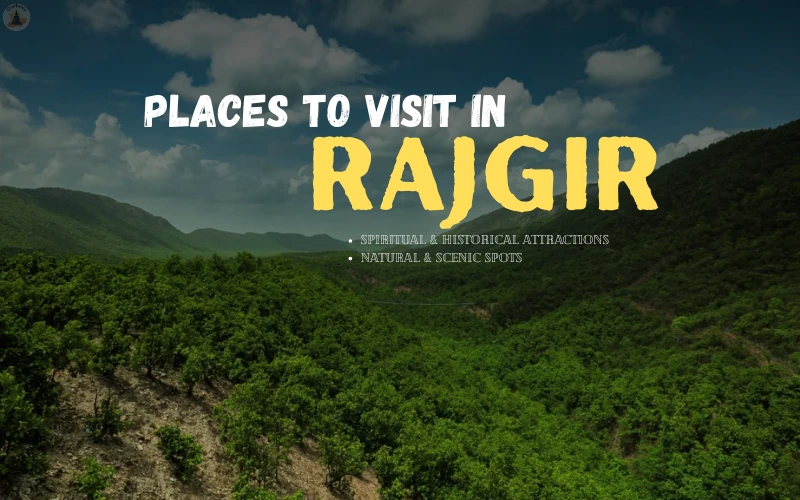
Rajgir, located in the Nalanda district of Bihar, a places to visit in rajgir are rich in spirituality, history, and Natural Beauty. This ancient city, which is well-known for its connections to Lord Buddha and Mahavira, welcomes thousands of pilgrims, history Lovers, and tourists each year. Rajgir has something to offer everyone, including Buddhist monasteries, Jain temples, ropeways, and hot springs. This is a comprehensive list of Rajgir’s must-see destinations if you’re organising a trip.
Table of Contents
Spiritual & Historical Attractions Places to Visit In Rajgir
1. Vishwa Shanti Stupa (World Peace Pagoda)
One of India’s most popular Buddhist destinations, this magnificent white stupa was constructed by Japanese Buddhists and is perched atop the picturesque Ratnagiri Hill. The stupa is a popular destination for pilgrims and tourists due to its serene atmosphere and stunning architecture. A ropeway ride that offers stunning panoramic views of Rajgir’s surrounding hills allows visitors to reach the site, enhancing the trip’s adventure and tranquilly. It is a must-see location because of its natural beauty and spiritual significance
Know More About Vishwa Shanti Stupa (World Peace Pagoda)
2. Griddhakuta Hill (Vulture’s Peak)
It is thought that Lord Buddha gave many of his most significant sermons at this hallowed location, imparting lessons that still motivate millions of people worldwide. As such, it has great historical and spiritual significance. It is a highly regarded location for Buddhists, providing a profound sense of connection with the wisdom and life of the Enlightened One. The area is also popular with hikers and nature enthusiasts because it is encircled by beautiful scenery, tranquil hills, and an abundance of greenery. Its spiritual legacy and breathtaking natural beauty make it a must-visit location for dedicated pilgrims as well as tourists looking for adventure, tranquilly, and breathtaking scenery.
Know More About Griddhakuta Hill (Vulture’s Peak)
3. Saptaparni Cave
The First Buddhist Council was held in this hallowed location soon after Lord Buddha’s passing, making it a site of great cultural, archaeological, and spiritual significance. His followers assembled here to memorise and recite his teachings, guaranteeing that his knowledge would be faithfully transmitted across the ages. In addition to being a significant point in Buddhist history, the location is now a marvellous archaeological find that provides information about long-gone customs and practices. The cave, surrounded by the breathtaking hills and forests, is a must-visit location for anyone looking for spiritual enlightenment as well as a window into the rich history of India. It draws pilgrims, historians, and inquisitive tourists alike.
Know Mare About Saptaparni Cave
4. Son Bhandar Caves
These intriguing rock-cut formations, which are thought to be ancient Jain caves, are thought to have been built in the third or fourth century AD and are outstanding examples of early Indian craftsmanship and architecture. They are believed to have been used as shelters and places of meditation by Jain monks who were looking for seclusion and spiritual practice. They were expertly carved into the rocky hillsides. Local legends imply that these caves once held hidden treasures, which adds to their mystery and appeal and keeps tourists’ attention.
Know More About Son Bhandar Caves
5. Ajatashatru Fort & Bimbisara’s Jail
Magadh’s illustrious past is echoed by these intriguing ancient ruins, which tell timeless tales of its strong rulers who once influenced the path of history. The fort, which was constructed in the sixth century BCE by the powerful King Ajatashatru, reflects the magnificence of early Indian fortifications and is a monument to his strength and ambition. The notorious Bimbisara’s Jail, where King Ajatashatru imprisoned his own father, King Bimbisara, due to political and power pressures, is located within this historic complex. It is said that Bimbisara could still see Lord Buddha at the neighbouring Griddhakuta Hill from this prison, which would have given him comfort in his last days.
Know More About Ajatashatru Fort & Bimbisara’s Jail
6. Cyclopean Wall (Jarasandha’s Wall)
Originally spanning several kilometres, this enormous cyclopean wall was constructed to defend the ancient city of Rajgir. It was made of enormous stones that were carefully fitted together without the use of mortar. The wall, which is thought to have been built during the Magadhan kings’ rule, demonstrates the extraordinary architectural genius of early Indian engineering as well as the power and strategic planning of the time. Its enormous size and resilience in the face of centuries of weathering are evidence of the builders’ talent and foresight. The wall is believed to have functioned as a barrier that delineated the splendour of Rajgir, the former thriving capital of Magadh, as well as a defence mechanism against invasions.
Know More About Cyclopean Wall (Jarasandha’s Wall)
Natural & Scenic Spots in Rajgir
1. Venuvana (Bamboo Grove)
King Bimbisara of Magadh personally gave Lord Buddha this tranquil bamboo grove, known as Venuvan, which has great historical and spiritual significance. It is one of the first monasteries connected to the life of the Buddha because it is said that he frequently stayed here when he visited Rajgir. With its verdant surroundings, towering bamboo trees, and serene pond at its centre, the serene location is ideal for introspection, meditation, and rest. Pilgrims, monks, and tourists from all over the world are drawn to this place by the tranquil atmosphere and the soft rustle of the bamboo leaves.
Know More About Venuvana (Bamboo Grove)
2. Ghora Katora Lake
One of Rajgir’s most enchanting attractions is this unusual horse-shaped natural lake, which is encircled by lovely hills. Its unique horse-like shape adds to its appeal and draws tourists’ attention. A stunningly lovely scene that is ideal for leisure and relaxation is created by the calm lake waters, rolling hills, and lush vegetation. It has grown in popularity over time as a picnic location for families and tourists looking for tranquilly in the middle of nature. The lake’s seasonal habitat for migratory birds adds to its allure, making it a delightful destination for nature lovers and birdwatchers.
Know More About Ghora Katora Lake
3. Hot Springs (Brahmakund & Saptarshi Kund)
One of Rajgir’s most revered landmarks are the holy hot springs, which attract tourists due to their special combination of therapeutic and spiritual significance. These mineral-rich waters, which naturally emerge from the nearby hills, are thought to have potent therapeutic qualities that can treat skin conditions and offer calming relief. Hindus, Buddhists, and Jains have all revered the springs for centuries, and they come here to bathe as a devotional and cleansing ritual. Ancient legends add to their cultural significance and establish them as a site of respect and faith. The hot springs, surrounded by hills, temples, and serene natural beauty, provide not only healing but also a chance for introspection and spiritual enlightenment.
Know More About Hot Springs (Brahmakund & Saptarshi Kund)
4. Rajgir Zoo Safari & Nature Safari
The Rajgir Wildlife Safari, which spans an amazing 191 hectares, is an exciting place for those who enjoy the outdoors and adventure. With designated habitats for magnificent tigers, strong lions, playful bears, and elegant herbivores, it is divided into various zones that let visitors get a close-up look at the wild. Every area is intended to offer a genuine look into these animals’ lives in their natural habitats while also offering safety. In addition to the safari, the park offers the thrilling Nature Safari, which includes attractions like the Adventure Glass Skywalk Bridge that provide stunning aerial views of the valleys and hills covered in forests below. The safari promises an amazing experience for families, adventurers, and wildlife enthusiasts alike with its blend of wildlife exploration, breathtaking scenery, and exhilarating activities.
Know More About Rajgir Zoo Safari & Nature Safari
Jain Temples in Rajgir
Since Rajgir is strongly linked to the life and teachings of Lord Mahavira, the 24th Tirthankara, it is extremely significant to both Buddhists and Jains. Five magnificent hills—Ratnagiri, Vipul, Baibhar, Udaygiri, and Songiri—encircle the city and are home to numerous historic Jain temples. Devotees from all over India and beyond flock to these revered shrines, which are prominent pilgrimage destinations for Jainists and situated high on the hills. The temples are well-known for their calm ambiance, spiritual significance, and expansive views of Rajgir. As a sign of devotion, many pilgrims embark on a strenuous walk to these shrines, which serves as a chance to appreciate the area’s natural beauty as well as a spiritual quest.
Know More About Jain Temples
Nearby Attractions
1. Nalanda University Ruins
The ruins of Nalanda University, one of the most important educational institutions in ancient India and a proud UNESCO World Heritage Site, are only 12 kilometres from Rajgir. Thousands of students and faculty from all over Asia once resided and studied at Nalanda, which was founded in the fifth century CE and is frequently cited as the first and oldest residential university in history. Scholars from China, Korea, Japan, and Tibet were drawn to it because of its particular reputation as a centre of Buddhist philosophy, logic, mathematics, astronomy, and medicine. With its monasteries, temples, lecture halls, and exquisitely designed courtyards, the expansive complex is a testament to both architectural and intellectual magnificence. The ruins continue to evoke wonder and serve as a testament to India’s rich educational and cultural legacy.
Know More About Nalanda University Ruins
2. Veerayatan Museum
An outstanding cultural organisation devoted to conserving and presenting the rich legacy of Jain art, philosophy, and history is the Jain Museum in Rajgir. It contains a remarkable collection of artefacts, ancient manuscripts, sculptures, and stone carvings that illustrate the teachings and life of Lord Mahavira and other Tirthankaras. Numerous centuries-old exhibits provide insightful perspectives on the artistic traditions, spiritual practices, and cultural impact of Jainism in the area. Beautifully crafted idols, intricate architectural fragments, and relics that showcase the craftsmanship of ancient artisans are all on display for visitors to admire. In addition to being a historical treasure trove, the museum is a significant learning hub for scholars, devotees, and inquisitive tourists who want to learn more about Jain culture.
Know More About Veerayatan Museum
Things to Do in Rajgir
- Ride the ropeway to the Vishwa Shanti Stupa.
- To unwind, explore the hot springs.
- Trek the hills of Rajgir.
- See the Nature Safari’s glass bridge.
- Take pleasure in boating at Ghora Katora Lake.
Travel Tips for Rajgir
- The best time to go is between October and March, when the weather is ideal for sightseeing.
- How to Get There: Rajgir has its own train station, and Patna, the closest airport, is about 100 kilometres away.
- Accommodation Options: Rajgir has some mid-range resorts, guesthouses, and inexpensive hotels.
Conclusion
Rajgir is the ideal fusion of nature, history, and spirituality. Rajgir offers something special for everyone, whether they are adventurers, history buffs, or pilgrims. Every area of Rajgir has a fascinating story to tell, from the serene Vishwa Shanti Stupa to the exhilarating Glass Bridge.
FAQ’s About Rajgir
1. What is Rajgir famous for?
In addition to its historical ruins like Ajatashatru Fort, Rajgir is well-known for its Jain temples, hot springs, Vishwa Shanti Stupa, and its association with Lord Buddha and Mahavira.
2. How many days are enough to explore Rajgir?
The best time to visit Rajgir’s main attractions is two days. Three days are suggested if you also intend to visit Nalanda.
3. What is the best time to visit Rajgir?
October through March is the ideal time of year to visit Rajgir because of the pleasant weather for outdoor activities and sightseeing.
4. How can I reach Rajgir?
Rail and road connections to Rajgir are excellent. About 100 kilometres away, Patna has the closest airport. Regular trains run from Patna and other cities to Rajgir’s own railway station.
5. Is Rajgir safe for tourists?
Yes, tourists are safe in Rajgir. It is a well-liked travel and pilgrimage site. Nonetheless, it is recommended to take simple safety measures, such as keeping your possessions secure.
6. Can I visit Nalanda along with Rajgir?
Yes, Nalanda and Rajgir can be easily visited in a single day because they are only 12 km apart.




Leave a Reply